My goal is twofold: bring in as much real science as I can, to represent the sort of home-made, DIY tech that a teen gadgeteer would use, and also make the most of a few basic elements: light elements like hydrogen and carbon, and versatile tricks like the skyhook system.
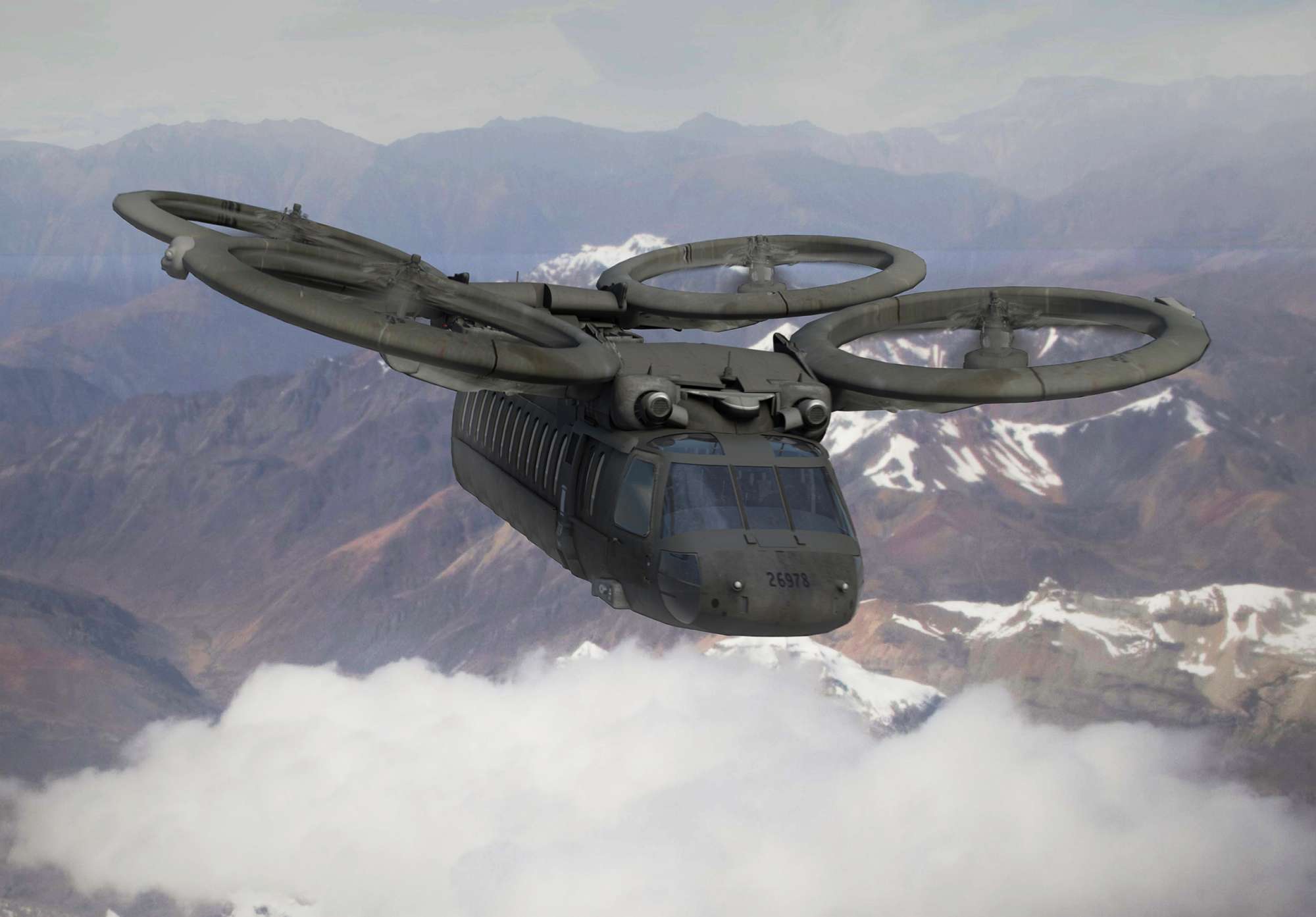
I’d say you can visualize about… 20 guys lined up on either side of the central opening, ready to slide to the ground on ropes. So… yeah. The big models probably carry 40 to 50 guys.
There are smaller models, all the way down to one-man things like this (below), but bladeless.
Actually, we can take this into a whole visual style for the Vyortovian tech. Hybrid ground/air vehicles…
Smaller troop transports (just picture it sleeker):
Q. How can the EmDrive produce enough thrust for terrestrial applications?
A. The second generation engines will be capable of producing a specific thrust of 30kN/kW. Thus for 1 kilowatt (typical of the power in a microwave oven) a static thrust of 3 tonnes can be obtained, which is enough to support a large car. This is clearly adequate for terrestrial transport applications.
We can build flight into Otto, Pneuma, and the Link Suit.
Note however, because the EmDrive obeys the law of conservation of energy, this thrust/power ratio rapidly decreases if the EmDrive is used to accelerate the vehicle along the thrust vector. (See Equation 16 of the theory paper). Whilst the EmDrive can provide lift to counter gravity, (and is therefore not losing kinetic energy), auxiliary propulsion is required to provide the kinetic energy to accelerate the vehicle.
The system works best for levitation, but we’ll still need rockets for any decent speeds.
Basically, a combination of directed ultrasound and laser-induced plasma can create open-air 3D holograms that people can safely touch. We don’t yet have the engineering to produce actual force fields that can push things around, but using something like an EMdrive whose output can be directed, you might be able to create that effect.
In our comic-book universe, of course, super-inventors have already solved these challenges, but production costs and the difficulty of maintaining the devices, as well as safety considerations, limit them to key government installations, high-tech labs, prototype weapon systems, and the like.
We have some characters who can quick-change costumes or “flip” into a different look (Concord’s transform, Pneuma’s armor up, Numina’s hologram). So here’s a real-world color changing dress and what it actually looks like: https://www.reddit.com/r/interestingasfuck/comment…
To save you from reading reddit comments, it’s like wearing a Kindle (so don’t wash it or go out in the rain). The illusion of motion I got from it is also interesting (and a little disorienting - imagine seeing a dozen people all cycling through patterns).
Doyce’s Segway-chair post in General Inspiration got me thinking back to a problem comics often face: how to depict differently abled characters in a universe where the prevailing technology both could and might fix it. I think one solution is to think outside the usual box: instead of asking ourselves, “how would we want to bring this character back to being like us”, we can ask “how would the character want to continue using their current strengths?” And that gave me this exchange:
Jason: Hey Maury, Leo and I are here to talk about funding a prosthetic kit for improved mobility. Are you–
Maury: Big fuck-off gorilla arms.
Jason: What?
Maury: Exoskeletal robot arms that I can control with my own arms. Strong enough to lift me and let me brachiate.
Jason: What?
Maury: Brachiate. Forward locomotion with the arms–
Jason: I got that part. But are you…
Maury: Can you do it?
Leo: Yeah, it’s technically feasible.
Maury: And I want that guy’s grappling hook system built in too. *points at Leo*
Leo: What?
Maury: And hardpoints for cameras. And like a drone docking deal. With recharging contacts. And…